A liquid-fill check is only as reliable as its tare, density correction, weighing method and acceptance rule. By the end, you will be able to calculate net fill mass, choose the right scale for bottles, vials, drums or tanks, and investigate failures caused by the product, container, filler or weighing environment.
Key takeaways
- Subtract empty-container tare from filled mass to calculate net fill weight.
- Convert labelled volume using measured product density at the recorded temperature.
- Match the scale’s capacity, readability and platform to each container format.
- Control vibration, movement, airflow and dripping before accepting weighing results.
How to calculate and accept a liquid fill by weight
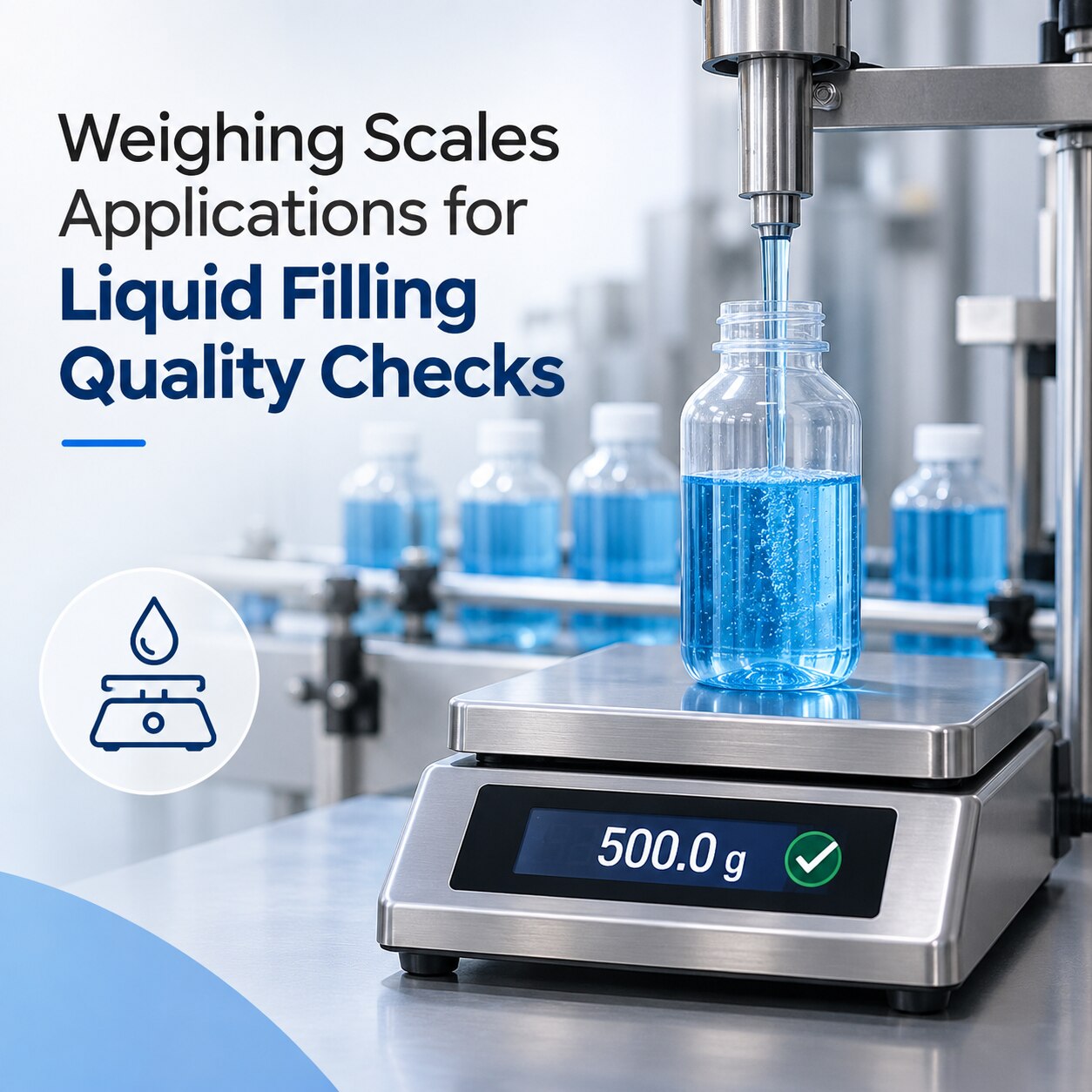
Net fill weight equals filled-container mass minus the empty-container tare. The result is grams or kilograms, not millilitres; convert it to volume only with the product’s measured density at the recorded temperature. Treat 1 g as 1 mL only when density is effectively 1.000 g/mL under those conditions.
1. Verify the balance is level, clean, within its calibration status, and stable. Check zero, place a known check mass or reference container, and record the balance ID, operator, time, product temperature and check result.
2. Weigh each empty container, cap or closure in the same configuration used after filling. Record its tare, or use a verified tare value only when containers are controlled tightly enough that tare variation cannot affect acceptance.
3. Fill the container, wipe product from the exterior without removing liquid from inside, allow the reading to stabilise, and record gross mass. Calculate net fill as gross mass minus tare mass.
4. Compare every net result with the approved target and individual lower and upper limits. Calculate the sample average separately, then apply the specified sampling rule and OIML R 87 requirements; an acceptable average does not rescue excessive individual deficiencies.
5. Release the lot only when the average and individual-package criteria pass, all records are complete, and no abnormal zero, check-mass, temperature or handling result remains unexplained. This is the core of liquid filling quality weighing in Vadodara, and it makes weighing scales liquid filling quality evidence traceable rather than merely numerical.
Convert the labelled volume into a valid weight target
The valid net-mass target is the labelled volume multiplied by the product density at the temperature of the fill decision. A 500 mL product with a density of 0.920 g/mL therefore has a target net mass of 460 g, not 500 g.
Record density in g/mL and temperature in °C. Measure the density at the same temperature as the filled container, or apply a documented density–temperature relationship. If density rises or falls with cooling or heating, the correct weight target changes even though the label still says 500 mL.
For temperature-sensitive liquids, a balance alone cannot prove compliance with the volume claim.
Treat 1 g as 1 mL only when the product density is effectively 1.000 g/mL at the stated measurement temperature. Water-like behaviour at one temperature does not justify that shortcut for oils, syrups, solvents or concentrated formulations.
For weighing scales for liquid filling quality checks in Vadodara, define these values in the work instruction:
- Labelled volume, such as 500 mL
- Reference temperature for the density
- Density value or approved correction equation
- Calculated target net mass
- Permitted lower and upper mass limits
Calculate net mass as filled-container mass minus empty-container tare. If the tare, product temperature or density basis changes, recalculate the target rather than reusing an old gram value.
Choose the scale for bottles, vials, drums and tanks
Use a bench scale for routine bottle, jar and drum checks; choose a semi-micro balance only when the permitted fill tolerance genuinely approaches the sub-milligram level.
| Option | What it measures | When it applies |
|---|---|---|
| Bench scale | Static gross mass minus tare, with practical capacity and fast stabilization | Bottles, jars and drums where tolerance is measured in grams or several milligrams |
| Semi-micro balance | Very small mass changes with high readability and repeatability | Small vials or laboratory fills requiring sub-milligram resolution; protect it from drafts, vibration, temperature shifts and evaporation |
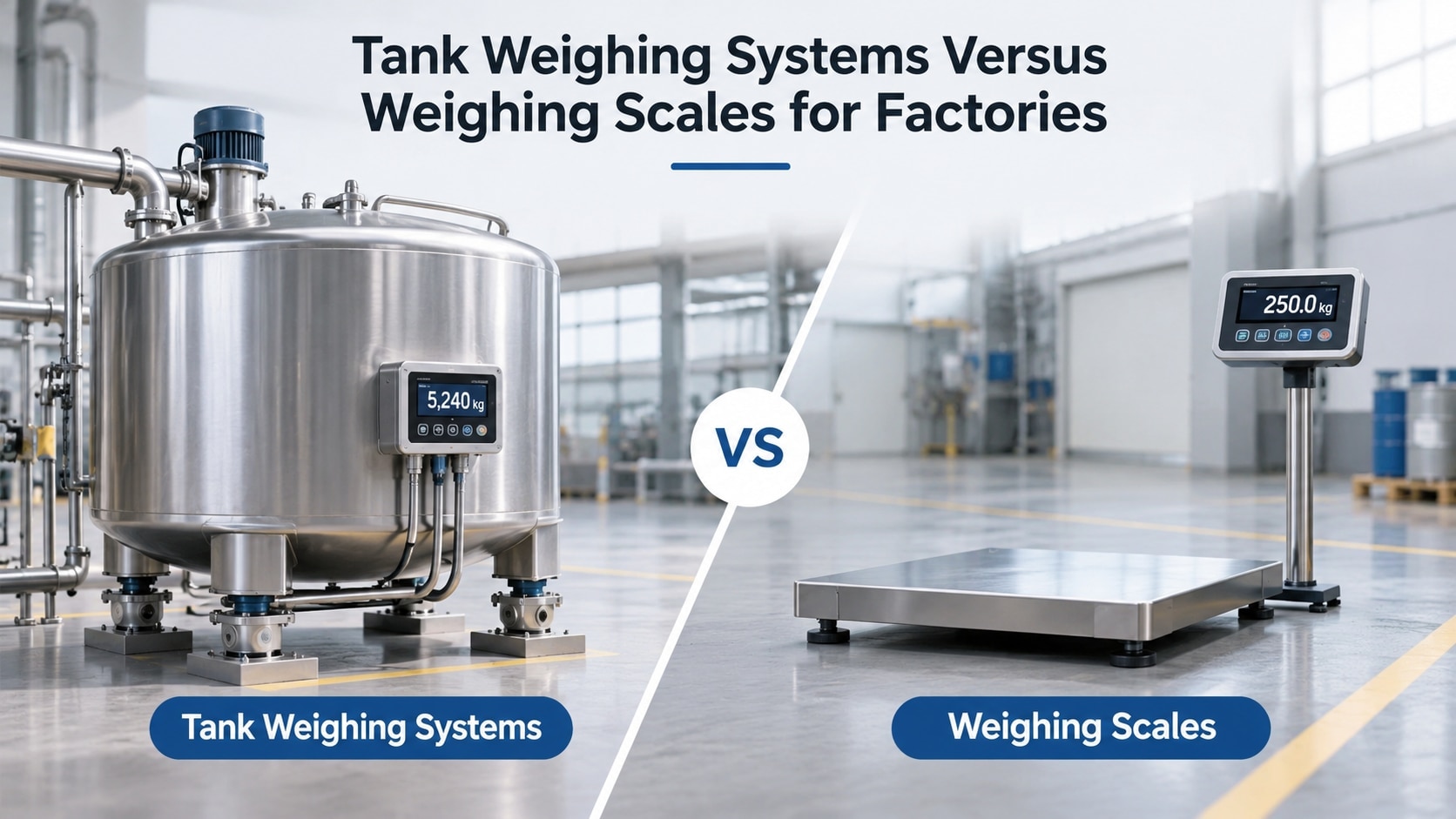
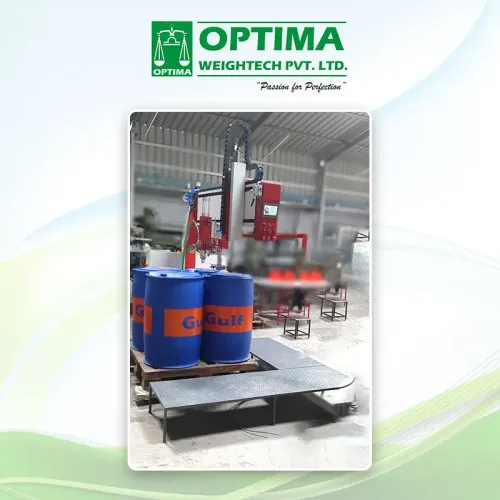
| Tank weighing system | Mass held in or transferred through a vessel using load cells | Bulk tanks, intermediate vessels and batch transfers; it does not prove that every bottle received the correct quantity |
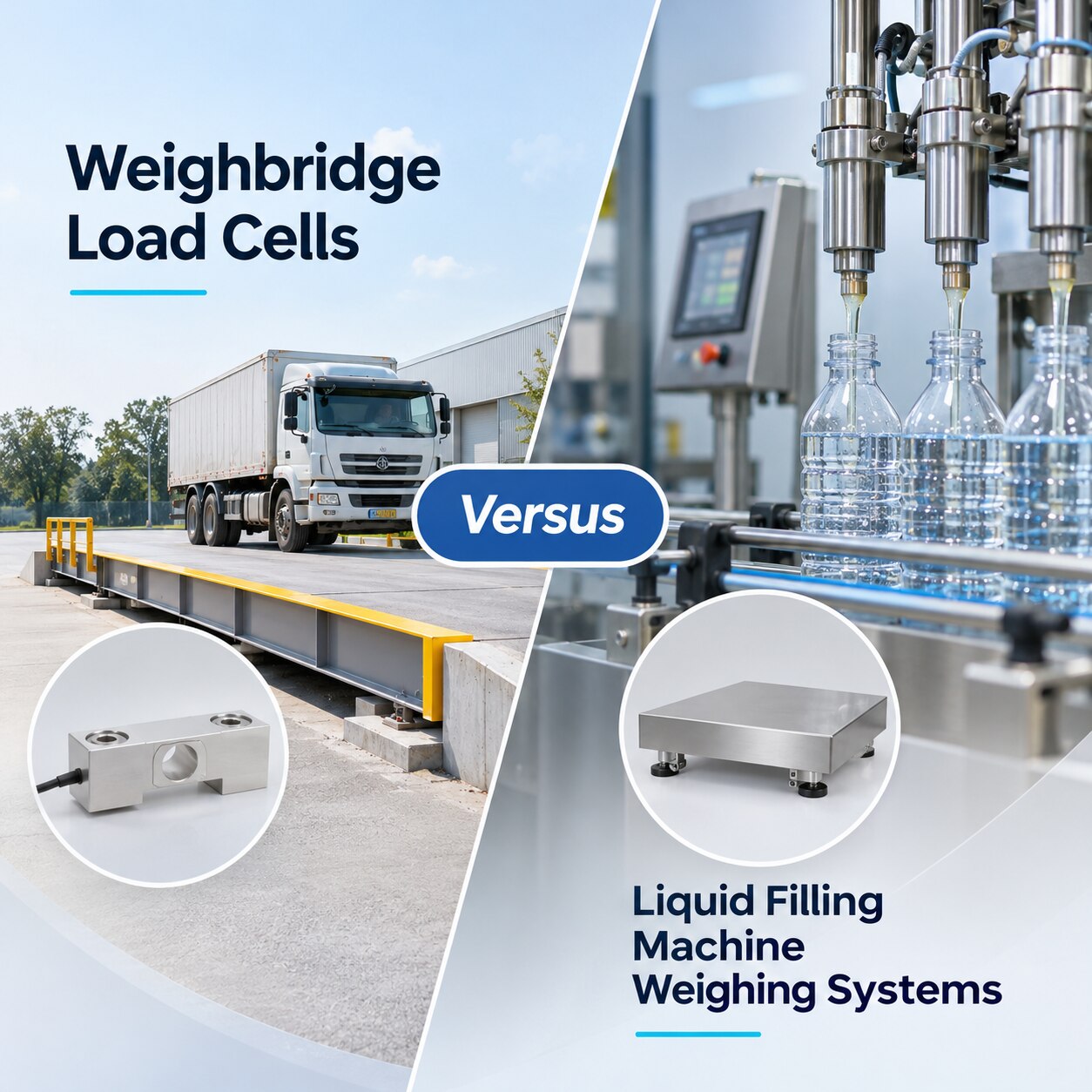
| Dynamic online checkweigher | Moving containers at line speed, with automatic reject or alarm | 100% screening of filled bottles, vials or cans after filling; conveyor vibration, spacing and speed can create dynamic errors |
For semi micro balance liquid filling in Gujarat, do not select resolution alone. If your production tolerance is several milligrams or grams, a verified precision or industrial balance can give faster, steadier decisions than a delicate semi-micro instrument.
Choose weighing scales for liquid filling quality checks in Vadodara by matching capacity, resolution, stabilization time and cleaning exposure to the vessel and product. Use the dynamic unit for process control, then compare scheduled samples on a static reference balance for diagnosis.
Confirm that pan, seals, cable glands and load-cell enclosure resist the actual product and cleaning chemicals; an IP rating alone does not prove chemical compatibility.
Prevent false failures during static and dynamic weighing
Liquid movement, foam and a dripping nozzle can make a correctly filled container fail the check. Wait for the liquid to settle before static weighing, and use the same delay after dispensing for every sample.
Control each source of variation with a defined method:
- Foam traps air and temporarily increases apparent volume. Settle or remove foam consistently; never skim only failed samples.
- A swinging liquid surface shifts the reading. Use a stable vessel, fixed placement and a programmed stability criterion.
- Drips from the nozzle add mass after the recorded fill. Keep the nozzle position and cutoff timing constant, then weigh after the same interval.
- Evaporation lowers the mass of an open volatile product. Use a cover, controlled weighing time and a stated time from opening to reading.
- Wet exteriors add false mass. Wipe every container using the same procedure, without removing product from the closure or seam.
- Tare variation from different containers, closures or residue corrupts net mass. Record each empty-container tare or use a verified tare class.
- Vibration from pumps, motors and floors destabilises static readings. Isolate the balance and pause nearby movement during measurement.
- Conveyor speed, spacing and acceleration create dynamic errors. Validate the checkweigher at the actual line speed, container spacing and product level; reject unstable readings rather than averaging them away.
For liquid filling quality weighing in Vadodara, calibration confirms the scale’s relationship to standards, not the complete method. A weighing scales liquid filling quality procedure needs controlled timing, temperature, vessel handling and sampling, with static checks diagnosing the dynamic system.
Validate the method, records and equipment before relying on results
A balance is not validated because its display agrees with a test weight. Calibration confirms the instrument’s relationship to standards; it does not prove that your vessel, product, sampling interval and handling produce a reliable fill decision.
1. Define the sample before production starts. Record the number of containers, sampling interval, container type and acceptance rule. For each sample, check zero, verify tare with an empty container, weigh the filled container repeatedly, and calculate net mass as filled mass minus tare mass.
2. Record enough information to explain a failure: product temperature, balance ID, operator, time, lot or batch number, calibration status and reference check-mass result. A known check mass or reference container at the start and end of the run can expose drift that a single calibration certificate cannot.
3. Control the surroundings. Shield the balance from draughts, vibration, direct sunlight, nearby motors and unstable benches; allow containers and product to reach the stated measurement temperature. Record density and temperature when converting mass to millilitres.
4. Match cleaning materials to construction. For weighing scales for liquid filling quality checks in Vadodara, check the pan, seals, cable glands and load-cell enclosure against the actual chemical, concentration, temperature and contact time. An IP rating does not prove chemical compatibility.
5. Confirm the Legal Metrology verification seal, certificate, model approval details and permitted capacity or accuracy class before using the instrument for a regulated transaction. Apply OIML R 87’s average-quantity and individual-deficiency tests; average fill alone cannot release a batch.
A semi-micro balance liquid filling in Gujarat is justified only when sub-milligram control is necessary. Ask Optima Weightech Pvt Ltd. to document method suitability, not just calibration, before selecting equipment.
Related products
 | Online Check Weigher The Online Check Weigher is a dynamic, high-precision weighing solution designed for continuous weight verification of packaged products on... View product → |
 | Ours is a firm committed to quality and has been manufacturing a qualitative range of these On-Line Check Weigher. View product → |
Frequently asked questions
How do you calculate and accept a liquid fill by weight?
Subtract the empty-container tare from the filled-container mass. Record the result in grams or kilograms, then compare it with the approved acceptance limits.
How do you convert labelled volume into a valid weight target?
Measure the product’s density at the recorded temperature and multiply volume by density. Treat 1 gram as 1 millilitre only when density is effectively 1.000 grams per millilitre under those conditions.
Which scale suits bottles, vials, drums and tanks?
Select capacity above the gross container mass, readability suited to the tolerance, and a platform that supports the container securely. A semi-micro balance suits small, tight-tolerance samples; drums and tanks need higher-capacity equipment with stable support.
How can you prevent false failures during static and dynamic weighing?
Stabilise the container, control vibration and airflow, prevent nozzle drips, and allow the reading to settle before recording it. During dynamic checks, define the sampling point and account for product movement.
What must you validate before relying on liquid filling results?
Validate the weighing method, density measurement, acceptance limits, tare procedure, equipment suitability, calibration status and records. Keep container identity, batch number, temperature, readings and operator details traceable.
Related products
 | Fully Stainless Steel Bench Scale Fully SS table top scale from capacity 3 kg to 30kg, Class II Accuracy Steel Bench Scale Manufacturers in Surat, Gujarat, India. View product → |
 | FORKLIFT WEIGHING The first forklift scale you can remove Slide a scale onto your forks in seconds. Remove it when weighing is not needed. View product → |
 | We are a trusted organization engaged in catering to the variegated requirements of the clients by providing optimum-quality Tank Weighing Systems. View product → |
Keywords